SendTech Times
News
CAPACITY TEST:

Telecom Operators Test Whether AI Networks Can Move From Opex Cuts To Revenue

Article summary

Communications service providers are using generative and agentic AI to automate network operations, but the next test is whether distributed connectivity, edge sites and secure infrastructure can become paid AI services.
Telecom Operators Test Whether AI Networks Can Move From Opex Cuts To Revenue
Image source: RCR Wireless News

Telecom AI Is Moving Beyond Cost Control

Communications service providers are using generative and agentic AI first to make networks cheaper and more reliable to run.

The operational case is already concrete: automation can handle complex network processes, improve performance indicators and reduce operating expense when operators prepare data, select use cases, integrate systems and validate changes carefully.

The industry benchmark cited for this shift is TM Forum’s Autonomous Networks Project.

Its maturity model has six levels.

Most service providers still place themselves at Level 1 or 2 across the whole network, while some leading operators have validated Level 4 processes in narrower domains.

Those Level 4 examples show why AI operations are becoming more than a lab exercise.

China Mobile has reached Level 4 in network operations centers using agentic and generative AI.

The cited outcomes are a 30% cut to operations-and-maintenance staffing requirements and another 30% improvement in the mean time to repair faults and customer complaints.

Rakuten Mobile has reached Level 4 in RAN energy efficiency, with an expected 20% improvement in radio access network energy efficiency.

Swisscom has also validated Level 4 in IP transport, where the result is cost savings and faster service-extension timelines.

Networks Become Part Of The AI Infrastructure Stack

The next question is whether operators can sell AI-era infrastructure, not just use AI internally.

Service providers control distributed connectivity and compute assets that are relevant to customers looking for data localization, low latency, security and proximity to users, devices and data.

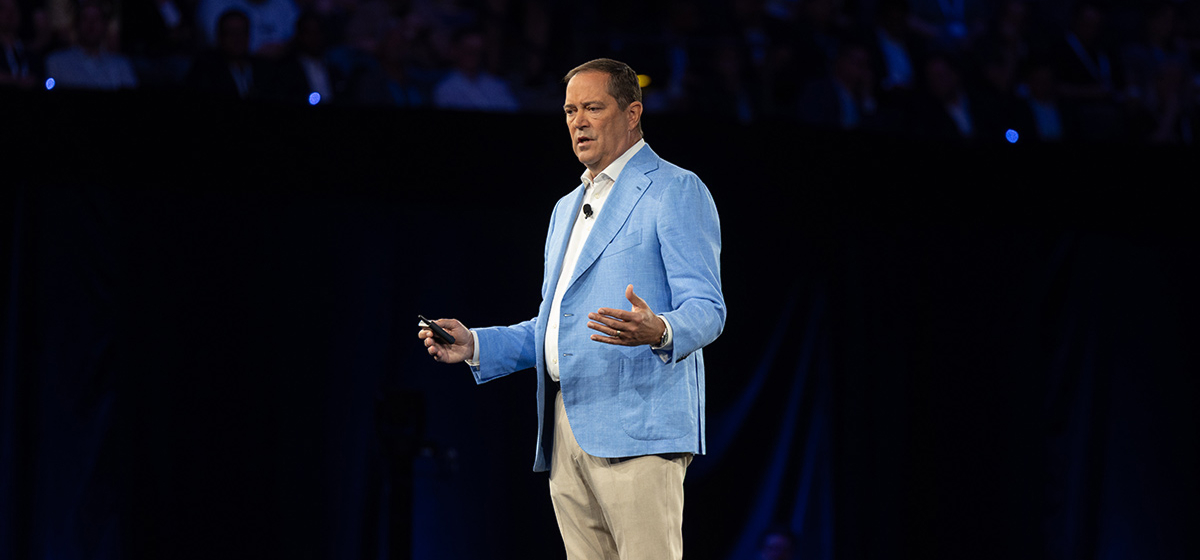
Cisco chair and chief executive Chuck Robbins described the opening as a path for operators to define their role in monetizing AI.

His point was that AI needs bandwidth, distributed infrastructure, secure connectivity and closeness to users and data, all areas where telecom operators already have assets.

That argument also changes how old network sites are viewed.

Robbins pointed to central offices and mini data centers spread across telecom networks as locations that could be reused in the AI era.

Instead of treating those sites only as legacy infrastructure, operators can assess whether they support edge compute, AI inference, sovereign AI services or GPU-as-a-Service.

Enterprise Demand Will Test The Edge Thesis

AT&T’s Andy Forester framed the moment as different from earlier edge-compute cycles.

He said edge compute had been like a use case searching for a market for the last 10 to 15 years.

The difference now is enterprise demand for workload-placement choices: inside company facilities, closer to edge sites, in dedicated AI data centers or through hybrid designs.

That creates a practical test for communications service providers.

Private 5G and multi-access edge computing were often sold with a build-it-first mentality.

AI workloads are less forgiving because architecture depends on the use case, data location, latency profile, security model and business outcome.

The final checkpoint is whether operators can turn autonomous-network progress into customer-facing AI revenue.

The present business case is opex reduction.

The stronger telecom infrastructure story will require paid services around connectivity, edge capacity, security policy and workload placement for enterprises adopting agentic AI.


Share this article
inXf

Related articles

More
AFL’s AI Interconnect Thesis Moves Data Center Networks Into The Bottleneck
Telco & Connectivity

AFL’s AI Interconnect Thesis Moves Data Center Networks Into The Bottleneck

AFL’s Noah Taylor framed data center interconnect as a critical constraint for AI infrastructure, arguing that hyperscale networks now need denser fiber, faster deployment and tighter ecosystem integration as inference shifts more traffic upstream.

Ciena Says AI Data Centers Will Need More Than One Optical Network Design
Telco & Connectivity

Ciena Says AI Data Centers Will Need More Than One Optical Network Design

Ciena executive Helen Xenos says AI data center interconnect will mix coherent optics, photonic line systems, full-spectrum transponders, co-packaged optics and liquid cooling as scale-across deployments push capacity and reliability demands higher.

AT&T’s OSS/BSS Token Strategy Turns Telco AI Costs Into A Network Test
Telco & Connectivity

AT&T’s OSS/BSS Token Strategy Turns Telco AI Costs Into A Network Test

An AT&T network architect outlined how tokenized OSS/BSS data, edge processing and internal models can reduce telecom AI cost, including 27 billion daily tokens and a 90% generative AI cost reduction claim.

Anterix And Lynk Test Satellite-To-Device Links For Utility Networks
Telco & Connectivity

Anterix And Lynk Test Satellite-To-Device Links For Utility Networks

Anterix and Lynk Global are testing whether 900 MHz private wireless spectrum can extend satellite-to-device connectivity into utilities and other critical infrastructure networks.

Keep Reading

More Stories

Latest
Revolut’s UAE Licences Put Its Digital-Banking Launch Closer To MarketEconomyJun 17, 2026Revolut’s UAE Licences Put Its Digital-Banking Launch Closer To MarketRevolut has secured UAE central bank permissions for stored value and retail payment services, moving the fintech closer to a full local launch while it builds partnerships and operations.CPP Investments Puts ₹70 Billion Behind India’s AI Data-Center BuildoutCloud & Data CentersJun 17, 2026CPP Investments Puts ₹70 Billion Behind India’s AI Data-Center BuildoutCPP Investments is backing CtrlS with up to ₹70 billion, adding pension-capital weight to India’s race to build data centers for cloud and AI workloads.Plasma One Tests Whether Stablecoins Can Behave Like Everyday BankingEconomyJun 17, 2026Plasma One Tests Whether Stablecoins Can Behave Like Everyday BankingPlasma has launched Plasma One, a stablecoin banking app that combines wallet, payments, yield and underlying blockchain infrastructure into one consumer account.Arada's London Debut Tests Gulf Capital In Prime Residential DevelopmentReal EstateJun 17, 2026Arada's London Debut Tests Gulf Capital In Prime Residential DevelopmentSharjah developer Arada has unveiled 100 Avenue Road in Swiss Cottage, a 172-apartment London project that extends its UK expansion after acquiring Regal and backing Thameside West.Spotify's AI Music Push Faces A Global Consent TestAIJun 17, 2026Spotify's AI Music Push Faces A Global Consent TestSpotify has about 761 million users in 184 markets, but its next AI music tools will be judged by whether licensed covers, remixes and artist identity protections can scale across non-English growth markets.Flagright Raises $12.5 Million As AI Compliance Moves From Tools To WorkflowsFintech & Digital PaymentsJun 17, 2026Flagright Raises $12.5 Million As AI Compliance Moves From Tools To WorkflowsFlagright raised a $12.5 million Series A led by Infinity Ventures to expand explainable AI workflows for financial crime compliance, with banks, fintechs and credit unions as the stated market focus.Intel 18A-P Enters Risk Production, But Foundry Proof Still Runs Through YieldChips & SemiconductorsJun 17, 2026Intel 18A-P Enters Risk Production, But Foundry Proof Still Runs Through YieldIntel has started risk production of its 18A-P node, adding performance and power claims to its foundry pitch while outside-customer commitments, Arm manufacturing proof and packaging capacity remain the next tests.AWS WAF Turns AI Bot Access Into A Paid Edge ControlAIJun 17, 2026AWS WAF Turns AI Bot Access Into A Paid Edge ControlAWS WAF added AI traffic monetization for CloudFront-protected content, letting publishers set per-request prices for verified and unverified AI agents while routing x402 stablecoin payments through third-party facilitators.UAE Creates AI And Data Authority To Put Agentic AI Inside GovernmentPoliticsJun 17, 2026UAE Creates AI And Data Authority To Put Agentic AI Inside GovernmentThe UAE has approved a new Artificial Intelligence and Data Authority that will combine public data, AI and digital-government functions under one Cabinet-linked body. Omar Sultan Al Olama will chair the authority, which takes over mandates previously spread across the AI office, the TDRA digital government sector and the UAE Data Office. The move makes federal data quality, AI platforms and digital service design part of one operating structure as the government pushes agentic AI into public administration.Listen Labs Raises $69 Million To Scale AI Customer InterviewsAIJun 17, 2026Listen Labs Raises $69 Million To Scale AI Customer InterviewsListen Labs raised $69 million after running over one million AI-powered interviews, testing whether AI moderation can make customer research faster without losing participant quality.Qwen Goes Physical: Can Alibaba’s Robot Models Navigate Real Homes?AIJun 17, 2026Qwen Goes Physical: Can Alibaba’s Robot Models Navigate Real Homes?Alibaba released Qwen-Robot, an embodied AI model family covering navigation, manipulation and world modeling for physical agents. The suite includes Qwen-RobotNav, Qwen-RobotManip and Qwen-RobotWorld, with Qwen-RobotNav shown on a Unitree Go2 robot using a single low-resolution camera. The launch gives Alibaba a concrete robotics layer around Qwen, but the evidence in the source is still a technical demonstration rather than broad commercial deployment.Public First Poll Shows China AI Leads In Perception But Trails On TrustAIJun 17, 2026Public First Poll Shows China AI Leads In Perception But Trails On TrustA Public First poll covering over 18,000 people across 15 countries found respondents in 11 nations viewed China as ahead in AI capability and innovation. The same survey showed a trust gap: US AI models ranked second on net trust at +16, while China placed 10th at -8. The findings land as China pushes its AI Plus strategy and Chinese models such as Alibaba Qwen3.7-Max and Zhipu GLM-5.1 appear in top Code Arena rankings.